
Real Gemstone Beads vs Simulated Beads Differences in Appearance and Price
- Aug 22
- 9 min read
Updated: Aug 23
A strand of beads can look expensive at first glance and still cost only a few dollars. Another strand may look quiet, imperfect, and understated, yet carry a much higher price. That is the tricky part of buying gemstone beads: beauty alone does not tell the whole story.
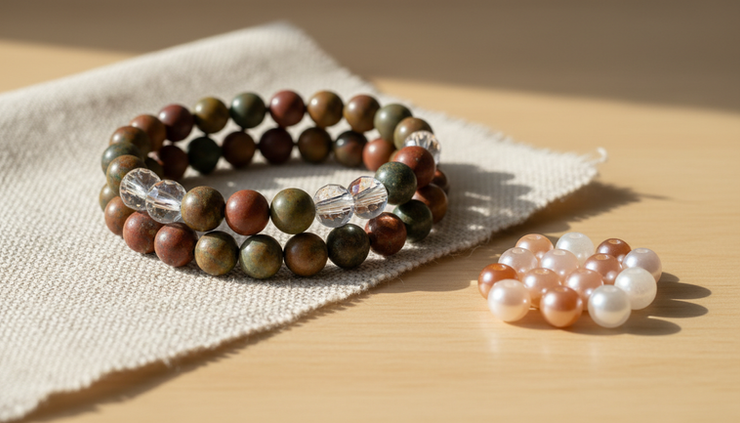
Real gemstone beads and simulated beads can both make attractive jewelry. The difference is what they are made from, how they look up close, how they wear over time, and why their prices can be so far apart. Understanding those differences helps you choose the right beads for bracelets, necklaces, earrings, prayer beads, craft pieces, or resale designs.

What real gemstone beads are
Real gemstone beads are cut from natural mineral material or organic gem material that formed in the earth or in nature. Common examples include amethyst, garnet, rose quartz, tiger’s eye, jasper, agate, lapis lazuli, moonstone, turquoise, and citrine.
Some real gemstone beads are untreated. Many are treated in accepted ways to improve color, strength, or surface finish. Heat-treated amethyst, dyed agate, stabilized turquoise, and enhanced jade are all examples buyers may see in the bead market.
That means real does not always mean untouched. It means the bead is made from actual gem material, even if that material has been cut, polished, drilled, or treated.
Natural gemstone beads are not all rare or costly
A common mistake is assuming every real gemstone bead should be expensive. Some stones are abundant and easy to cut, so they remain affordable. Picture jasper, snowflake obsidian, red jasper, clear quartz, and many agates can be real while still costing far less than premium stones.
Price rises when the material is rare, clean, vivid in color, difficult to source, or desirable in the current market. A strand of high-quality aquamarine or fine turquoise will usually cost much more than a strand of common quartz, even though both may be real.
What simulated gemstone beads are
Simulated gemstone beads are made to look like a gemstone without being that gemstone. They may be glass, resin, plastic, ceramic, composite material, dyed howlite, or another lower-cost stone styled to resemble a higher-value gem.
For example:
Blue dyed howlite is often sold as a turquoise lookalike.
Glass beads may imitate jade, malachite, opal, moonstone, or lapis.
Resin beads can mimic amber, coral, or horn.
Composite beads may copy stones with bold matrix patterns.
Simulated beads are not automatically bad. They can be colorful, consistent, durable enough for fashion jewelry, and budget-friendly. The problem starts when they are sold as real gemstones without clear labeling.
There is also a difference between synthetic and simulated. A synthetic gemstone has the same basic chemical composition as its natural counterpart but is grown in a lab. A simulated gemstone only looks like the stone it copies. For bead buyers, simulated materials are usually chosen for appearance and price, not gem identity.

How real and simulated beads differ in appearance
The easiest place to start is the surface. Real gemstone beads often show small variations from bead to bead. Simulated beads often look more uniform, especially in color and pattern.
That does not mean every perfect-looking bead is fake. High-grade natural stones can be beautifully matched. It also does not mean every irregular bead is real. Manufacturers can add speckles, veins, bubbles, swirls, and dye to create a natural look.
Still, certain visual clues help.
Real gemstones often have natural variation
Natural gemstones rarely look identical across every bead in a strand. One bead may be slightly lighter. Another may have more internal cloudiness. A third may show a vein, band, crystal pocket, or mineral inclusion.
This is especially true with stones such as:
Jasper
Agate
Labradorite
Moonstone
Rutilated quartz
Turquoise
Lapis lazuli
Malachite
With these stones, the beauty often comes from variation. Patterns shift. Colors move. No two beads look exactly the same.
Simulated beads tend to repeat. A strand may show the same swirl, same matrix line, or same color concentration over and over. In glass or resin, patterns can look too even or too controlled.
Inclusions can be a good sign
Inclusions are tiny internal features inside natural gemstones. They can look like wisps, clouds, needles, flecks, fractures, or mineral spots. In many beads, these are normal.
Clear quartz, amethyst, citrine, and garnet may show internal features under light. Labradorite may show flashes that appear from certain angles. Moonstone may have a soft glow that moves as the bead turns.
Simulated glass can also contain bubbles or swirls, but those features look different. Air bubbles in glass are often round and isolated. Natural inclusions are usually more irregular.
A simple way to inspect beads is to hold them near a bright window or use a small flashlight. Turn the bead slowly. Real stones often reveal depth. Simulated materials may look flatter or more surface-focused.
Color can reveal a lot
Strong color does not always mean fake. Some gems are naturally vivid. Amethyst can be richly purple. Carnelian can be bright orange-red. Lapis can be deep blue. Malachite can be intense green.
The clue is whether the color looks believable for that material.
Dyed stones may show color collecting in cracks, drill holes, or surface pits. A bead can look blue on the outside but pale inside the hole. If the stringing cord is stained, that may also point to dye.
Simulated beads are often made in colors that appeal to buyers, even if the natural gem would rarely look that even or saturated. Bright pink “jade,” neon turquoise strands, and perfectly even deep purple bead strands should be examined with care.
Luster and surface feel can be different
Real gemstone beads usually feel cool at first touch because stone conducts heat differently than plastic or resin. Glass can also feel cool, so this test is not enough by itself.
Surface luster gives more clues. Polished natural stone often has a smooth, solid glow. Glass can appear extra glossy. Plastic and resin may feel lighter, warmer, or slightly softer.
Some simulated beads also show mold seams or coating wear near the drill hole. Natural stone beads may chip, but they do not usually peel unless they have a surface coating.
Weight can help, but it is not proof
Stone and glass tend to feel heavier than plastic or resin. Hematite, garnet, and many dense stones have a noticeable weight. Resin amber imitations can feel very light.
Still, weight varies by material. Real amber is also lightweight. Some glass simulations feel heavy. Use weight as one clue, not the final answer.
How price differs between real gemstone beads and simulated beads
Price is where the difference often becomes obvious. Simulated beads are usually cheaper because the materials are easier to produce, easier to match, and available in large quantities. Real gemstones require mining, sorting, cutting, drilling, grading, and sometimes treatment.
A lower price does not always mean simulated. A higher price does not always guarantee real. But price should make sense for the material being claimed.
Bead type | Typical price pattern | Why it costs that way |
Common real gemstones | Low to moderate | Material is widely available and easier to cut |
Premium real gemstones | Moderate to high | Better color, clarity, size, rarity, or source quality |
Treated real gemstones | Low to high | Price depends on base material and type of treatment |
Simulated glass beads | Low to moderate | Easy to produce in consistent colors and shapes |
Resin or plastic beads | Usually low | Low material cost and light weight |
Dyed lookalike stones | Low to moderate | Real stone is present, but it imitates a different gem |
Rarity raises the price of real beads
Rarity matters. High-quality turquoise, natural lapis lazuli with strong blue color, fine aquamarine, good ruby, sapphire, emerald, or higher-grade jade can command much higher prices than common stones.
Size also matters. Larger beads require larger pieces of usable gem material. A strand of 4 mm beads usually costs less than a strand of 10 mm beads in the same quality because larger clean pieces are harder to produce.
Matching also raises the price. A strand with beads that match closely in color, size, shape, polish, and overall grade takes more sorting. That labor adds cost.

Labor affects price more than many buyers expect
Gemstone beads do not appear ready-made. Rough material must be selected, cut, shaped, drilled, polished, inspected, and strung. Hard stones can be slower to cut. Fragile stones can break during drilling. Very small beads require precision.
Faceted gemstone beads cost more than smooth round beads because they take extra cutting. Unusual shapes, calibrated tiny beads, and high-polish finishes can also raise the price.
Simulated beads can be molded or made in large batches. That makes them easier to keep consistent and less expensive per strand.
Treatments can lower or raise value
Treatment is common in the bead world. Some treatments are widely accepted. Others reduce value if they are used to make low-grade material look like something much finer.
Examples include:
Heat treatment to improve color
Dyeing to create stronger or different color
Stabilizing to strengthen porous stone
Coating to add shine or surface effects
Reconstituting crushed stone with resin or binder
A treated real gemstone can still be real. A dyed agate bead is still agate. A stabilized turquoise bead can still contain turquoise. But the treatment should affect the price and should be disclosed when it matters.
A strand sold as “natural turquoise” should not be priced the same if it is dyed howlite, reconstituted material, or plastic imitation.
Side-by-side clues for shoppers
No single test can identify every bead. The best approach is to compare several clues at once.
What to check | Real gemstone beads often show | Simulated beads often show |
Pattern | Irregular natural changes | Repeated or printed-looking designs |
Color | Slight variation across beads | Very even or extra bright color |
Drill holes | Stone color continues inside, unless dyed | Paint, coating, or dye may collect near holes |
Surface | Polished mineral feel | Glassy, plasticky, coated, or molded feel |
Weight | Varies by stone, often solid | Resin and plastic feel lighter |
Price | Reflects rarity, grade, size, and labor | Usually lower and more consistent |
Listing language | Names the gem and treatments | Uses words like “style,” “look,” or “imitation” |
Be careful with vague names. Terms such as “turquoise color,” “jade style,” “opal effect,” or “lapis look” may signal a simulation. They are not always misleading, but they do not mean the bead is the named gemstone.
Also watch for names that sound gem-like but are really trade names or color descriptions. If the exact material is unclear, ask.
When simulated beads are the better choice
There are good reasons to choose simulated beads. They are useful for designs where color, consistency, or price matters more than gem identity.
Simulated beads may be a smart choice for:
Large craft projects
Trend-based jewelry
Children’s jewelry
Costume pieces
Practice designs
Lightweight earrings
Color-matched collections
Budget-friendly gifts
They also make sense when the natural version is too rare, too fragile, too expensive, or restricted in availability. For example, simulated coral or amber-style resin may suit a design without raising the same cost or sourcing concerns as natural material.
The key is honest labeling. If a bead is glass, resin, or dyed stone, it should be sold that way.
When real gemstone beads are worth the higher price
Real gemstone beads are worth considering when the material itself matters. Some makers and buyers want the natural variation, weight, history, and mineral identity of stone. Real beads can give a piece depth that simulations struggle to copy.
They are often worth the higher price for:
Fine handmade jewelry
Collector strands
Spiritual or symbolic pieces
Heirloom-style designs
Pieces intended for resale
Designs focused on natural materials
Real stones also age differently. A polished stone bead may develop a soft patina over time. It can chip or scratch, depending on the mineral, but it will not usually peel like a coated imitation.
For resale, accuracy matters even more. Calling simulated beads real can damage trust. Clear descriptions protect both the seller and the buyer.
How to buy with more confidence
Start by comparing the claim, the appearance, and the price. If a strand is described as high-grade natural gemstone but costs far less than similar strands, ask why. It may be treated, lower grade, smaller, mislabeled, or simulated.
Read product descriptions closely. Good listings often mention the exact material, bead size, treatment, shape, strand length, and whether color is enhanced. A short description is not always a warning sign, but missing details make it harder to judge value.
Ask direct questions when needed:
Is this bead made from natural stone, glass, resin, or another material?
Has the stone been dyed, stabilized, heated, coated, or reconstituted?
Does the color go through the bead or sit on the surface?
Are the photos of the actual strand or a sample strand?
Can you provide close-up photos of the drill holes and surface?
For higher-value gemstones, buy from sellers who understand gem materials and disclose treatments. For very expensive strands, a lab report may be useful, though most everyday bead strands do not come with one.
The clearest difference is value, not just looks
Real gemstone beads and simulated beads can both be beautiful. The real difference is value. Real beads carry the value of natural material, rarity, cutting labor, grading, and sometimes treatment history. Simulated beads carry the value of design, color, consistency, and affordability.
Choose real gemstone beads when authenticity, natural variation, and material identity matter. Choose simulated beads when you want a specific look at a lower price or need consistent color for a design.
The best purchase is not always the most expensive strand. It is the strand that is honestly described, fairly priced, and right for the piece you want to make.
The Difference Between Gemstone and Simulated Beads


Comments